Fertilizer Bags
Urea, ammonium bicarbonate, NPK blends and single superphosphate are the hardest fill for a woven sack: hygroscopic, often acidic, dense, and stacked for months before they reach the field. This page explains how the construction is chosen — and what to send us so it is right the first time.
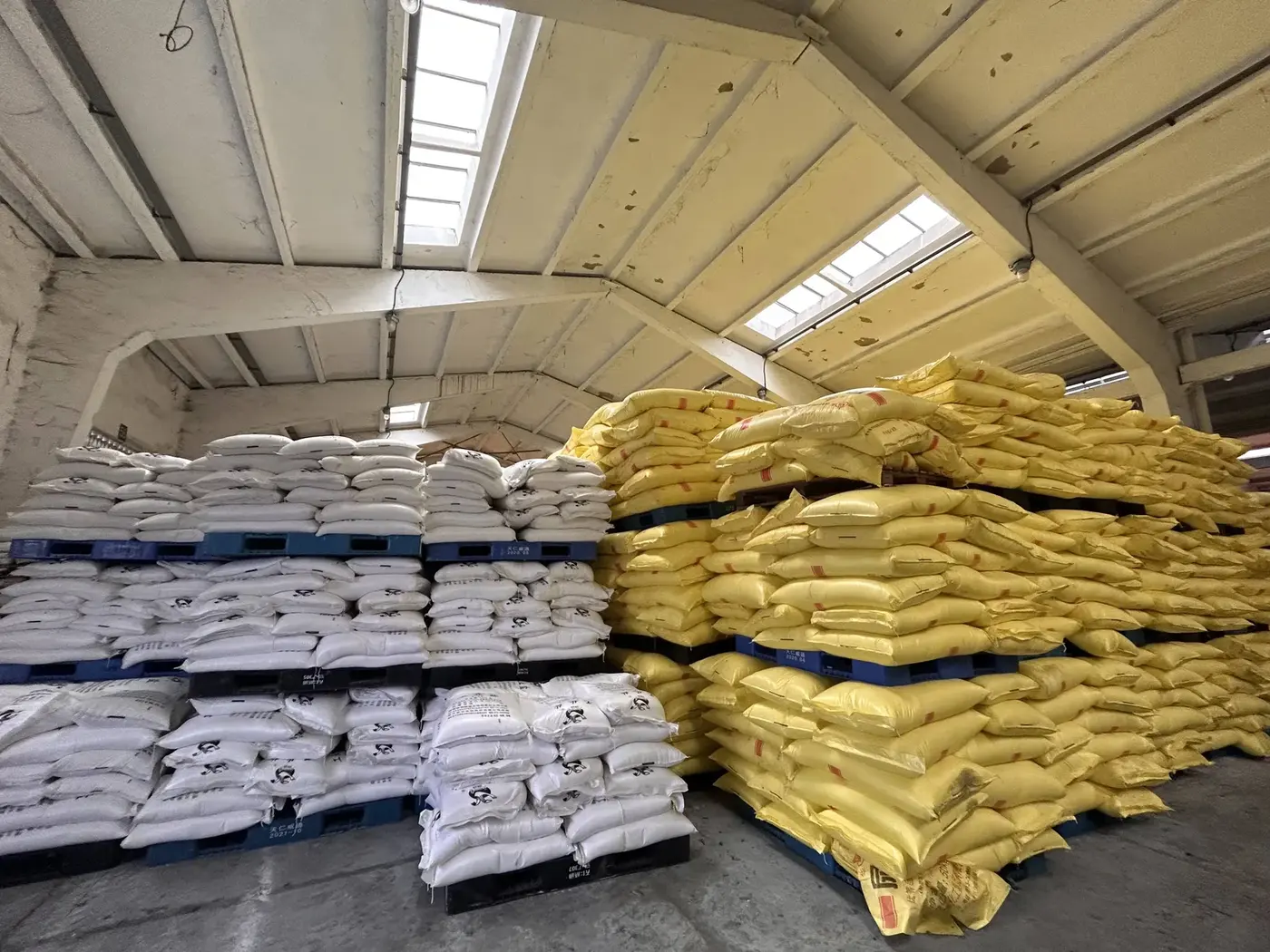
A bag that looks fine on the filling line can still fail in the warehouse
Fertilizer is packed at 25–50 kg, stacked 10–15 layers high, and often stored through a humid season. The failure rarely happens at filling — it happens three weeks later, when the granules have fused into a block or the bottom seam has opened.
Because we weave the fabric ourselves — 550+ circular looms, 11 production lines — the fabric weight, weave, coating and liner are set per order against your product and route, not quoted as one standard size.
- Fabric 60–120 gsm · yarn 600–2000D · weave 10×10 to 18×18
- Fills 10–50 kg — 25 kg and 50 kg cover most fertilizer volume
- PE coating 18–25 g/m² per side, or BOPP lamination for retail print
- Liner 0.04–0.08 mm, single or double stitched bottom, paper-lined option
Four Reasons Fertilizer Bags Fail
Almost every complaint traces back to one of these. Which one dominates your product decides the structure — not the fabric weight alone.
Moisture → caking
Urea starts absorbing water at roughly 72–75% relative humidity. Granules fuse into blocks that will not flow, and the nutrient distribution in the bag stops matching the label.
Free acid & salt crystallisation
Single superphosphate carries free phosphoric acid. Dissolved salts soak into the weave, re-crystallise inside the yarn structure and wedge the tapes apart from the inside.
Bottom and seam failure
25–50 kg of dense material concentrates stress exactly where the bag is stitched. Thin fabric, a single seam or the wrong thread gives way during handling, not during filling.
UV oxidation outdoors
Polypropylene has no natural UV resistance. Impact strength drops long before the fabric looks damaged, so a bag that still carries load can split on a fork truck.
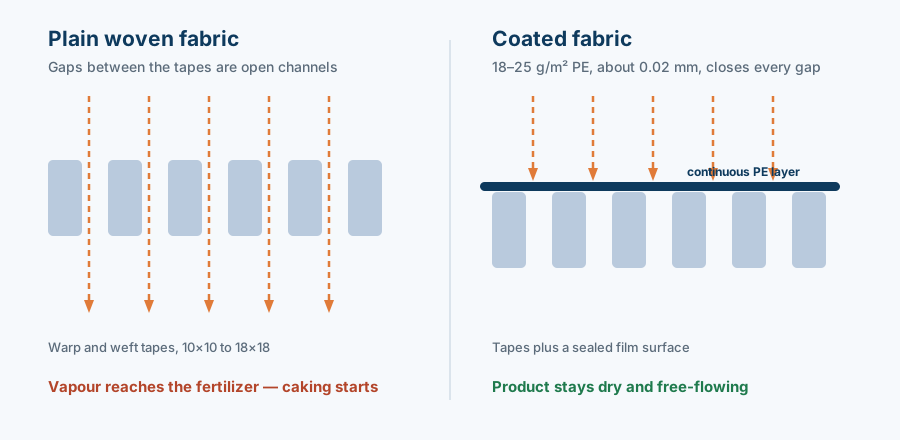
The Weave Is a Mesh, Not a Barrier
Even a tight 10×10 weave leaves channels between warp and weft. Water vapour does not need a hole — it passes through the gaps that make the fabric flexible in the first place. This is why "use a thicker fabric" does not solve caking: more grams per square metre make the bag stronger, not drier.
What stops vapour is a continuous film. Either a coating on the outer fabric, or a separate LDPE liner inside — and the liner is the part doing the real work.
- Coating: 18–25 g/m² per side (about 0.02–0.025 mm); double-sided 38–50 g/m² total
- Liner: 0.04–0.06 mm for NPK, DAP and MAP; 0.05–0.08 mm for urea and ammonium bicarbonate
- A folded or tied liner mouth leaves the barrier open — the liner has to be sealed
Why a Liner Is Not Optional for SSP
A common assumption is that fertilizer "eats through" the bag. The chemistry is less dramatic than that: polypropylene itself is stable against fertilizer salts and against solutions from about pH 2 to 12. The bag does not dissolve.
What actually happens is slower and more mechanical. Free acid plus oxygen plus heat accelerates oxidation of the polymer chain, so the fabric loses elongation before it loses tensile strength. At the same time, moisture carries dissolved salt into the weave, and every dry–wet cycle grows crystals inside the yarn structure — the tapes are wedged apart and the stitching is abraded from the inside. The result looks like corrosion: stiff, brittle fabric and seams that let go.
The answer is physical isolation, not additives. Anti-oxidant and anti-UV masterbatches slow ageing, but they do not stop acid contact. A PE layer between fertilizer and fabric — liner, coating, or both — does.
- Coated fabric with a liner: no bare weave in contact with the product
- For aggressive grades, a PP/PE laminate keeps the acid away from the load-bearing tapes
- Adding grams to a bare bag is the expensive way to solve the wrong problem
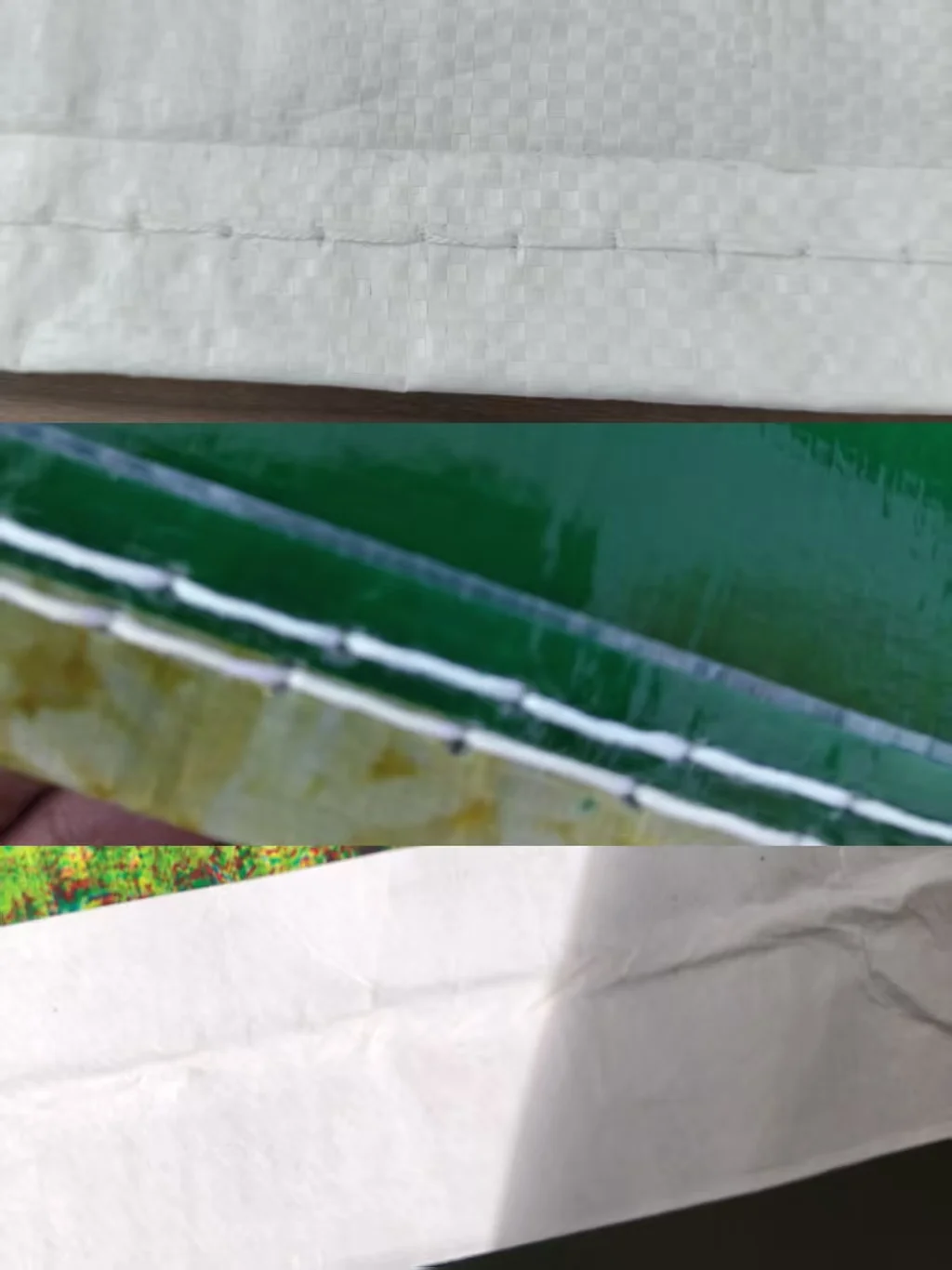
Three Tiers: Cost Rises With Protection
The bottom is the most common breakage point on a 25–50 kg fertilizer bag, and there is no single "best" closure — there is a trade-off. Choose by product form and route, not by habit.
| Bottom closure | Relative cost | Load range | Sifting protection | Use when |
|---|---|---|---|---|
| Single-row seam | Low | Light loads, up to about 25 kg | Basic — needle holes stay open | Granular product, short inland distribution, cost-driven volume |
| Double-row seam with folded hem | Medium | 25–50 kg | Good — two rows share the load and the hem closes the edge | Standard choice for granular and crystalline fertilizer, general export |
| Paper-lined bottom | Highest | 25–50 kg, fine powder | Best — a paper layer covers the needle holes stitching leaves behind | Fine or dusty product, high-value blends, long sea freight, humid destinations |
A single seam is not "bad" — it is simply the wrong choice for fine powder travelling three weeks by sea. Two details matter at every tier: stitch density of 8–12 per 10 cm with 3–4 back-stitches at both ends, and a 3-ply PP thread of 2,000–3,000D (about 0.5–0.7 mm) with single-end strength of 60 N or more. On a double-row bottom, both rows must be locked; a second row that merely follows the first adds cost without adding strength.
Sunlight Is the Other Failure Mode
Dealers and farms store bags outside. In direct sun, chain scission starts immediately and impact strength falls well before the fabric looks damaged.
Short-term exposure
UV masterbatch in the tapes is normally enough for transit, market stalls and a few weeks at the dealer.
Long-term open storage
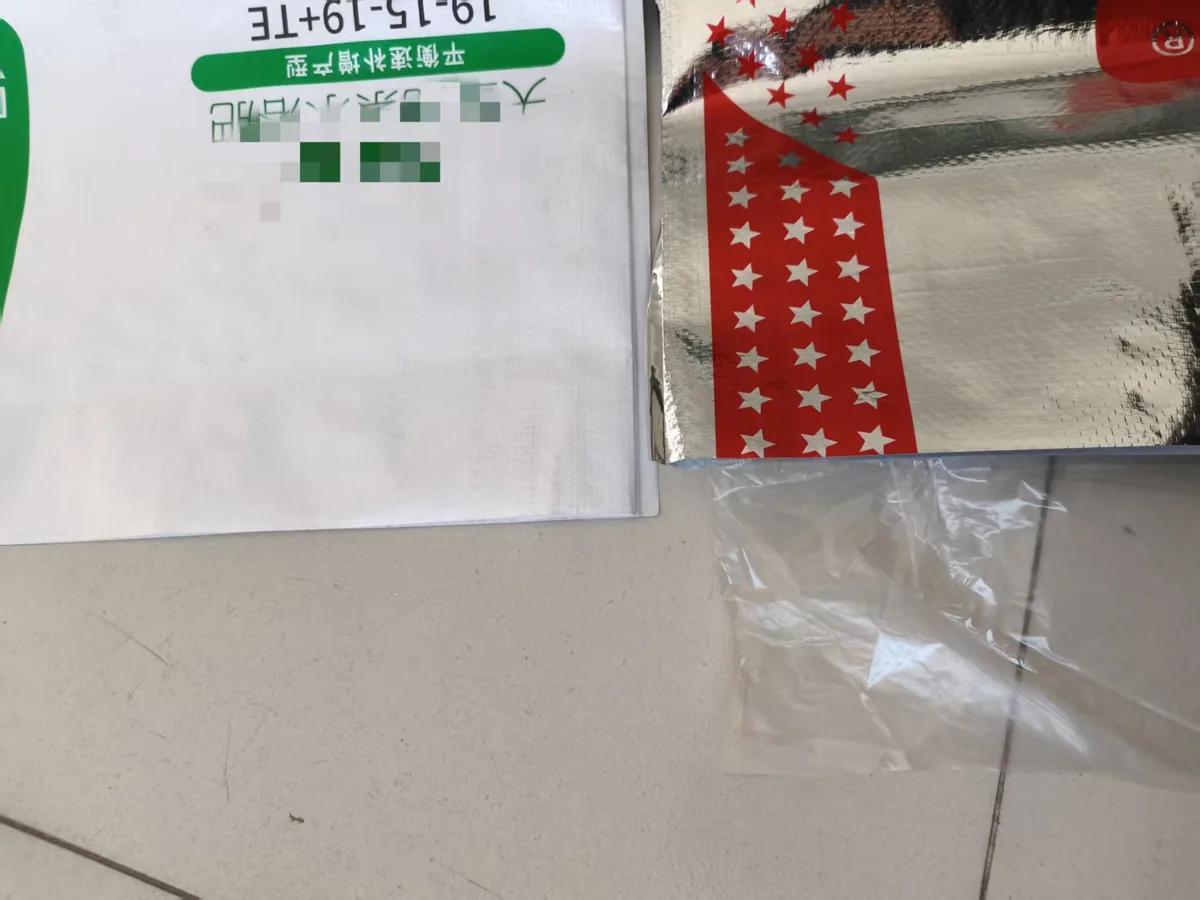
An aluminised or opaque coated structure reflects a large share of incident radiation and slows ageing measurably.
No life in years, by design
We do not quote a service life in years. Ask for accelerated ageing data (ISO 4892-2 or GB/T 16422.3) and, where volume justifies it, run an outdoor trial in your own climate.
Storage discipline
Keep stacks under cover and off the floor, and rotate stock. Stabiliser buys time; it does not replace a roof.
Size the Bag From Density, Not Habit
Bag dimensions follow from fill weight and bulk density. Copying a competitor's size works until your product is denser or lighter than theirs.
Volume (L) ≈ fill weight (kg) ÷ bulk density (t/m³) × 1.08
Example: 50 kg granular urea at roughly 0.75 t/m³ → about 67 L of product → a 72 L bag with 8% headspace for filling and settling. NPK blends at 0.9–1.0 t/m³ need noticeably less volume for the same weight, which is why a "50 kg bag" is not one size.
Two rules: keep 5–8% headspace so the bag is not drum-tight when it absorbs moisture, and confirm bulk density by measurement — it changes with granule size, coating and moisture content.
| Size (W × H) | Fill weight | Typical fertilizer | Fabric (reference) |
|---|---|---|---|
| 45 × 75 cm | 25 kg | NPK compound, blends | 85–95 gsm |
| 50 × 80 cm | 25–40 kg | Ammonium sulphate, MAP/DAP | 90–100 gsm |
| 55 × 95 cm | 50 kg | Urea, ammonium bicarbonate | 100–110 gsm |
| 60 × 100 cm | 50 kg | Urea, NPK, SSP | 100–110 gsm |
Reference values only — fertilizer sits at the heavy end of our 60–120 gsm range because of stack height and moisture exposure. Final fabric weight is confirmed with a drop test at your fill weight.
Match the Structure to the Fertilizer
Same mill, same fabric — different barrier. This is the starting point we work from when a buyer sends a product name instead of a specification.
| Fertilizer | Moisture risk | Typical structure |
|---|---|---|
| Urea (granular / prilled) | High | Coated woven + 0.05–0.08 mm LDPE liner, heat-sealed mouth |
| Ammonium bicarbonate | Very high, volatile | Coated woven + liner, sealed mouth; keep storage time short |
| NPK compound / blend | Medium–high | Coated woven + 0.04–0.06 mm liner |
| Single superphosphate (SSP) | Medium, acidic | Coated woven + liner mandatory; no bare weave against the product |
| Ammonium sulphate / chloride | Medium, saline | Coated woven + 0.05 mm liner |
| DAP / MAP | Medium | Coated woven + 0.04–0.06 mm liner |
| Organic / slow-release granules | Low–medium | Coated woven, liner optional |
PP Woven or BOPP-Laminated — Both Are Fertilizer Bags
Every sack on this page starts as the same woven PP tube off our circular looms. What changes is the outer skin: a PE coating applied over the fabric, or a printed BOPP film laminated onto it. Neither is "the" fertilizer bag — the choice follows your sales channel and your print budget, and the liner decision does not change.
PP Woven + PE Coating
60–120 gsm fabric with 18–25 g/m² of PE per side. The coating closes the weave, locks the print and stiffens the panel; the liner behind it does the real barrier work.
- Up to 4 colours — grade blocks, bold type, line art
- Textured surface that grips the pallet and the bag clamp
- Lower cost per bag — the default for industrial, tender and aid volumes
- The coated outer bag is sewn or valve-closed, not heat sealed
PP Woven + BOPP Film
70–120 gsm fabric carrying an 18–25 µm BOPP film, reverse-printed and then laminated on. The film becomes the visible surface, so the bag looks printed rather than woven.
- Up to 6 colours — photographic images, half-tones, gloss or matte
- Continuous film layer also resists scuffing in transit
- Slippery and stiffer — re-check clamp pressure and stack angle
- Higher cost: film, print plates and a lamination pass
- The laminated outer bag can be heat sealed at 180–200 °C
Decision rule. Industrial, tender, aid and dealer volumes → coated PP, and put the budget into liner thickness instead of decoration. Retail shelf and brand-led dealer bags → BOPP, and put it into print. Plenty of buyers run both: coated PP for the 50 kg line, BOPP for the 25 kg retail bag, cut from the same fabric.
One correction worth making, because it comes up in every tender: BOPP is biaxially oriented polypropylene, so a BOPP-laminated sack is still PP/PP, not a mixed polymer. The recycling penalty comes from the adhesive layer and full-surface ink, not from a second plastic. Either way, urea and ammonium bicarbonate still need a 0.05–0.08 mm LDPE liner with a heat-sealed mouth — the skin is a print and handling decision, not the moisture barrier.
Space on the Bag Is a Compliance Decision
Fertilizer packaging is regulated in most destination markets, and the required blocks take up real print area. Plan them before artwork, not after the plates are made.
- N-P-K grade and nutrient content, net weight, bags per pallet
- Batch, production date and handling symbols
- Country of origin, manufacturer or importer details
- Up to 4 colours directly on woven fabric; up to 6 colours on BOPP-laminated stock
Send artwork as AI, PDF or CDR with Pantone references, and tell us the destination country — we flag layout conflicts before plates are cut.
Send Your ArtworkMono-Material First, Recyclate Second
Fertilizer sacks are almost entirely PP and PE, which is good news for mechanical recycling — but only if the structure stays simple.
Mono-material designs (PP fabric with PP coating, or HDPE-heavy constructions) recycle far more easily than multi-layer laminates with metallised film. Where a customer needs print quality and recyclability at the same time, we look at the layer count before the decoration.
Regulatory pressure is dated, not vague. The EU Packaging and Packaging Waste Regulation sets recycled-content targets for plastic packaging from 2030 — around 35% for most plastic packaging, with woven sacks falling in the "other plastic packaging" category, rising to 65% by 2040. Confirm the exact obligation against the regulation text and your customer's own specification before committing to a recycled-content figure on the bag.
Practical sequence: optimise for recyclability first, then add post-industrial recyclate (PIR) where the application allows. For heavy-duty 50 kg sacks, a recyclable PP construction remains the more defensible route than switching to a biodegradable material that has not been proven at that load and shelf life.
What to Send Us for an Accurate Quote
Eight points. With all of them, we answer with a structure and a price instead of a question.
Fertilizer type and grade
Urea, ammonium bicarbonate, NPK 15-15-15, SSP, ammonium sulphate — the grade decides the barrier.
Fill weight per bag
10–50 kg. Tell us if the same bag must also run on a 25 kg line.
Size, or bulk density
Existing dimensions, or fill weight plus measured bulk density and we calculate the volume.
Fabric weight and liner
Your current gsm, and whether a liner is required — with thickness if you have a spec.
Coating or lamination
Single-side coating, double-side coating, or BOPP lamination for retail print.
Printing and artwork
Colour count, artwork file and the destination country for labelling rules.
Quantity and annual volume
First order and expected yearly volume, so we quote at the right price step.
Destination port and QA standard
Port, Incoterm, and any drop, seam-strength or ageing test your QA requires.
Fertilizer Bag Questions
The six questions buyers ask most before placing a first order.
For humid destinations and storage beyond a few weeks, yes. A coated bag alone slows moisture down; a 0.04–0.06 mm LDPE liner is what keeps the product free-flowing. For urea and ammonium bicarbonate we go to 0.05–0.08 mm.
Fertilizer sits at the heavy end of our 60–120 gsm range: 100–110 gsm for a 50 kg fill with a liner, and 85–95 gsm for 25 kg. Below 90 gsm on a 50 kg fill is where bottom failures usually start, so we confirm the construction with a drop test at your fill weight.
The liner can and should be heat sealed — a sealed liner mouth is the only way to close the moisture barrier. An uncoated woven outer bag cannot be heat sealed; it is sewn, or closed with a valve mouth on the filling line.
Yes, with UV masterbatch in the tapes. For long-term open storage we discuss an aluminised or opaque coated structure — and we will not quote a service life in years, because that depends on radiation, temperature and handling in your yard.
MOQ is typically 10,000–20,000 pcs depending on structure, size and number of print colours. Trial orders on standard constructions are possible — tell us the fill weight and destination and we will confirm.
10–15 layers, total stack height 2.5 m or less, on pallets or dunnage off the floor. Higher stacks compress the bottom bags, and compression combined with moisture is what turns granules into a block.
Choose the Base Construction
The fertilizer structure is built on one of these two bags. Both are woven in the same mill.
 Base Bag
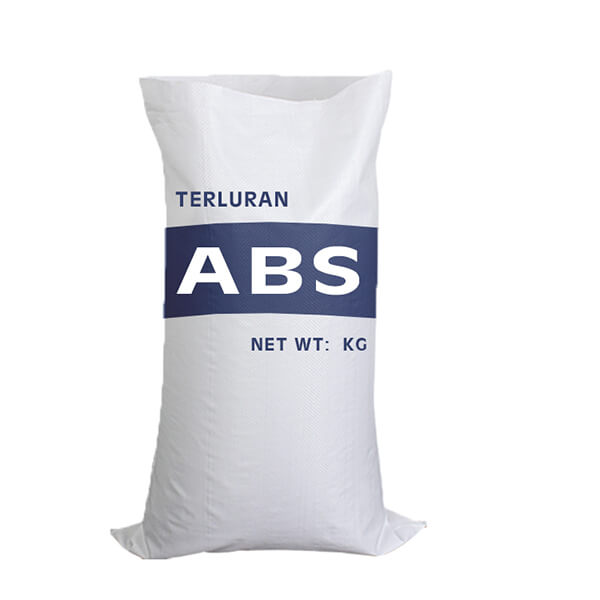
PP Woven Bags
60–120 gsm fabric, 600–2000D yarn, 10–50 kg fills, with PE liner and up to 4-colour print.
Full specifications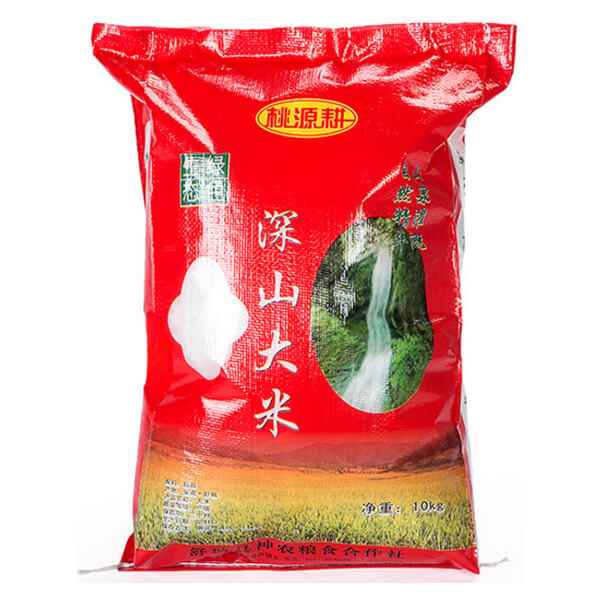 6-Color Print
BOPP Laminated Bags
Printed BOPP film laminated to woven fabric — photographic shelf appeal plus a moisture barrier.
Full specifications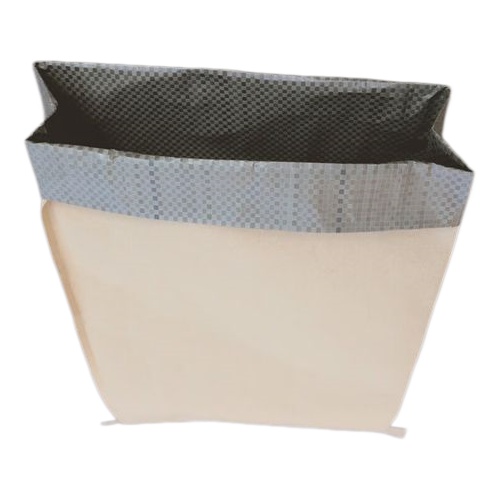
Paper-Plastic Composite Bags
Kraft paper plus woven PP for dust-tight packing of fine powders and powdered blends.
See the rangeSend Your Grade and Fill Weight
Tell us what goes in the bag and how it travels — we will propose the fabric, coating, liner and bottom closure that hold up, with a quotation.